
Tips On How To Tame Your Bird And Gain Its Trust


If you’ve just brought a bird home—or you’re finally ready to turn “coexisting” into real trust—this guide shows you exactly how to do it with positive reinforcement, short structured sessions, and clear milestones.
Every bird is an individual, but the phases below work well for small parrots like budgies and cockatiels, and scale to medium parrots with patience and consistency.
Before You Start: Set Up a Calm, Safe Space

A relaxed environment speeds up taming. Place the cage at chest-to-eye level in a low-traffic corner where your bird can observe without constant interruptions.
Keep lighting natural (no sudden darkness), and set a routine for feeding and quiet time so your bird can predict what comes next—predictability reduces stress.
Quick safety checklist (keep it brief):
Close windows/doors; switch off ceiling fans and cover mirrors if needed.
Remove toxic plants, tidy loose cables, and keep other pets out during training.
Offer high-value treats appropriate to species (e.g., millet spray for budgies, tiny nut pieces for larger parrots).
Prepare a neutral training perch so the hand isn’t the only option from day one.
How Trust Grows: A Four-Phase Plan

Short, consistent sessions beat long marathons. Think 5–10 minutes, 1–2 times a day, and advance only when your bird meets the phase criteria.
Phase 1 (Days 1–3): Acclimation & “You’re Safe With Me”
Sit near the cage and speak softly. Read a page aloud or work quietly on your phone so your presence feels normal.
Offer a treat through the bars or in a cup just inside the door—no pressure to approach.
If the bird leans away or fluffs tightly, increase the distance and try again later.
Advance when: your bird will take 3–5 treats while staying relaxed (soft feathers, normal breathing, subtle beak grinding later on).
Phase 2 (Days 4–7): Approach & Target Training
Target training is the fastest, kindest bridge to cooperation. Present a safe “target” (the tip of a chopstick, pen cap, or spoon).
When the bird touches the target with its beak—even accidentally—mark the moment with a short word (“Yes!”) and treat.
Gradually ask for one step toward the target before rewarding. Keep your hand still; let the bird choose to move.
Advance when: your bird will take 2–3 steps to follow the target and stay engaged for 5–7 minutes without signs of stress.
Phase 3 (Days 8–10): Stick Training & the First Step Up
Introduce a handheld perch or short stick. Target the bird onto the perch, reward, then target it off again. Add the verbal cue “step up” as the bird shifts weight forward.
If you use your hand, offer it as a stable platform, thumb tucked, and apply gentle pressure under the chest (not the belly) only if the bird already leans forward.
If it refuses, don’t force it—go back to the perch for a few more reps.
Advance when: your bird comfortably steps onto the perch (or hand) 3–5 times in a row and remains calm between reps.
Phase 4 (Days 11–14): Hand Confidence & Short Recall
Fade the perch. Use the target to guide a step up to your hand, reward, then step back to the perch. Begin micro-recall: perch to hand from 30–60 cm, then back.
Keep it game-like—two wins, take a break. If your bird free-flies indoors, practice recall in a closed, bird-proofed room once it’s happily targeting and stepping up.
Stay flexible: Some birds need a few extra days in a phase. That’s not failure—it’s good training.
Reading Body Language: The Signals That Guide Your Pace

Understanding what your bird says with its body protects trust and prevents bites. Use this quick reference while you train.
| Signal | Likely Meaning | What You Do Now |
|---|---|---|
| Leaning away, feathers tight | Uncertain or mildly fearful | Increase distance, lower criteria, shorten session |
| Eye pinning (pupils flashing) + tail fan | High arousal; could be excitement or irritability | Pause; switch to easy targets; avoid hands |
| Open beak/hiss, head low | Defensive warning | Stop. Give space. Return later with easier step |
| Relaxed feathers, soft beak grinding | Comfortable, winding down | Reward calm; end on a success |
| Gentle preening, soft chirps | Content, engaged | Continue brief, positive reps |
| Beak lunge (connects or near-miss) | Over threshold (fear or frustration) | End session calmly; reassess triggers and criteria |
Golden rule: If in doubt, make it easier—shorter distance, simpler behavior, bigger reward.
Rewards, Enrichment, and Motivation
Motivation isn’t just treats; it’s the whole environment. Rotate foraging toys, add safe shreddables (palm, paper), and vary perches so your bird’s day has texture and novelty.
Keep treats tiny—think sesame-seed size for small parrots—so you can reward often without overfeeding.
For water-loving species, a light mist or shower perch session can also be a powerful reinforcer after training.
The “Do Less, Achieve More” List (Common Mistakes to Avoid)

Don’t force contact. Pushing hands into the cage or chasing a bird only cements fear.
Skip marathon sessions. Two short sessions beat one long, exhausting attempt.
No punishment or scolding. It damages trust and will slow progress.
Don’t rush phases. Meet criteria first; then move forward.
Avoid mixed signals. Keep cues short and consistent (“step up”, “yes”).
A Simple Two-Week Starter Plan
This timeline is a guide, not a deadline. If your bird hesitates, extend the current step instead of pushing ahead.
Days 1–3: Acclimation; treats near you; no hands entering the cage yet. Goal: bird eats while you sit nearby.
Days 4–5: Begin target training at the cage door; reward every touch.
Days 6–7: Ask for 1–2 steps toward the target; position treats so your hand is visible but non-threatening.
Days 8–9: Introduce stick training; step onto the perch and off again, 3–5 calm reps per session.
Days 10–11: Add the “step up” cue; transition from perch to hand for 1–2 reps if relaxed.
Days 12–14: Short recall (perch → hand → perch) at 0.5–2 m in a safe room; finish with easy wins.
FAQs (Quick, Practical Answers)

How long does it take to tame a bird?
There’s no one answer. Some budgies warm up in 2–3 weeks of consistent, kind training; others need more time, especially if they’ve had stressful experiences.
Focus on tiny wins and trust the process.
What are good training treats?
Use species-appropriate, high-value items in tiny pieces: millet spray for budgies/cockatiels, small sunflower seeds (sparingly), or micro-bits of almond/walnut for larger parrots.
If your bird isn’t food-motivated, try access to a favorite toy, a quick look out the window, or a short cuddle after calm step-ups (if your bird enjoys touch).
Should I let my bird fly before it steps up reliably?
Start with controlled practice in a fully bird-proofed room after your bird targets well and steps up calmly.
Build recall at short distances first, so flight becomes another way to choose you, not a reason to avoid you.
What if my bird bites?
Bites usually mean the bird was over threshold. Don’t punish. End calmly, review what triggered the bite (too close, too fast, wrong moment), and lower the criteria next session.
If biting persists or fear is extreme, consider a consultation with an avian vet or certified behavior professional.
Keep Progress Going (Your Next Small Wins)
Trust is a living thing—you grow it a little every day. Keep sessions short, end on success, and celebrate the quiet moments when your bird chooses to be near you.
With positive reinforcement, clear body-language reading, and a pace set by your bird—not a calendar—you’ll build the kind of bond that feels effortless and lasts.
Enjoy This Video Tutorial About Birds
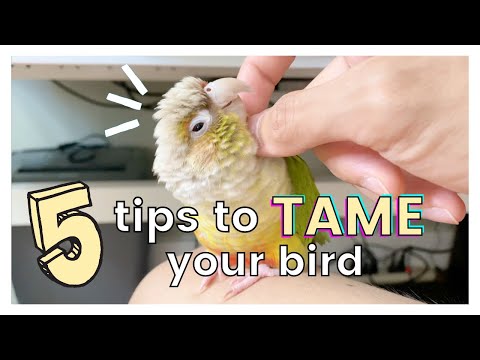
Source: Flying Fids
Did you find this post useful or inspiring? Save THIS PIN to your Pets Board on Pinterest! 😊

You may also like